How I got here…
In this first post, I want to introduce myself and my involvement with nursing and humanities. My name is Graham McCaffrey. I am an Associate Professor in the Faculty of Nursing at the University of Calgary in Canada.
I first trained as a registered nurse at St Mary’s School of Nursing in Paddington, London in the UK in the 1980s. Before that, I studied history at Cambridge University. Those contrasting experiences of education and training set the poles of my interests ever since – history, culture, language, interpretation and practical, applied, therapeutic relationships. I was always drawn to mental health nursing – it helped when the first thing our tutor for the mental health block at St Mary’s did was show us the film One Flew Over the Cuckoo’s Nest. My first taste of nursing and humanities.
After working for a couple of years on medical and surgical units in London, I went to work at the Cassel Hospital, a therapeutic community in Ham, near Richmond. The Cassel had (and still has: https://www.westlondon.nhs.uk/our-services/adult/mental-health-services/cassel-hospital) an unusual model of treatment for patients with severe difficulties in coping and relating in everyday life. First founded after the First World War to treat victims of shell shock, it evolved after the Second World War to incorporate developments in group psychotherapy and group dynamics. Patients were treated with psychodynamic psychotherapy (individually, in groups, and in families) while living as members of the community, in networks of social connection, responsibilities, and obligations that made up a microcosm of everyday life in society. The work of the nurses included collaborating with patients to carry out essential tasks of the community, such as cooking meals for around 50 people each day, cleaning, and running a pattern of scheduled unit and community meetings. Invariably, the pressures of social living that patients found hard to deal with were reproduced in the daily life of the community. Here, however, they could be addressed and discussed with nurses and in peer groups, as they emerged through practical problems that affected members of the community.
One feature of the Cassel was that we weaned patients off psychotropic medications when they first joined the community. It was only when I went to work on conventional mental health units I realised quite how radical that was. But working at the Cassel gave me a powerful experience of the strengths of therapeutic communication, of how much can be done using language to set boundaries, understand, make sense, offer solutions in response to problems arising out of the vicissitudes of social living.
Another application of the nurse-patient pairings at the Cassel was to run leisure activities. I started a poetry reading group with a young man, where a few of us would meet every week to read favourite poems. I still have my well-worn copy of Seamus Heaney and Ted Hughes’ anthology The Rattle Bag that was a popular source for poems that were satisfying to read out loud. My patient-partner started off the first meeting of the group with Larkin’s This Be the Verse, with its opening line: “They fuck you up, your mum and dad…”I was initially dismayed that my vision of a polite poetry reading group was crashing as soon as it started – and then thought, what better poem for this group in this place…
One more poetry related memory from the Cassel: A newly arrived patient at a weekend, when most patients were out on leave and I was the only nurse on duty. She was older than me and a social worker, struggling to come to terms with the role of patient. She recited from memory the whole of Sylvia Plath’s Lady Lazarus at me – an impressive performance and the only time I have felt a poem hurled at me like a weapon (“…And I eat men like air”).
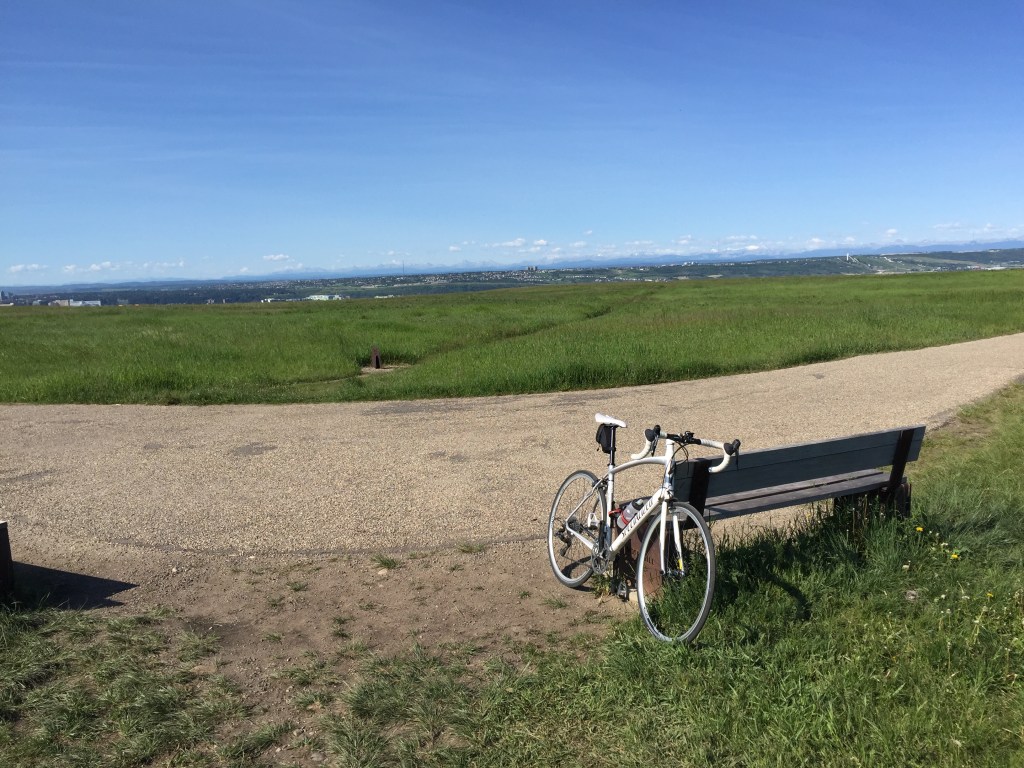
In the mid 1990s I immigrated to Canada, to Calgary in Alberta – the eastern slopes of the Rockies on the horizon in one direction, prairies stretching away in the other. I worked in geriatric mental health in a few roles, as a nurse on an inpatient unit, as part of a mental health consulting team to nursing homes, as outreach nurse and educator back on the unit. I learned about the interleaving of personal stories, medical histories, and capital H-History.
An elderly Chinese man who spoke no English, suffering from abdominal pains with no identifiable physical cause. He told me through an interpreter about how he almost starved as a child during the Japanese occupation in World War II, eating grass from the hillsides outside his village. Thirty years later, he left Vietnam and his business in Saigon after the Communist victory – as he talked about this in a Canadian hospital, another thirty years on, this dignified man became incensed at the memory, as though it had happened the week before.
Two women in a support group, struggling with anxiety and insecurity late in life. One talked about how, as a small child, she and her German family were expelled from their home in Czechoslovakia at the end of the Second World War. Another woman, Japanese Canadian, then told her story of being displaced with her family from their home on the West Coast of Canada during the war. Each of them recalled the exact weight of personal effects they were allowed to take with them, one in kilograms, one in pounds.
At this point in my career, I was finishing a post-diploma bachelor’s degree in nursing (having trained in pre-degree days). I realised I wanted to study nursing more deeply and applied to do a Master of Nursing degree at the University of Calgary. I had become involved in western Zen Buddhist practice, taking part in week-long silent retreats, and reading extensively in traditional as well as contemporary sources. I noticed parallels between Buddhist ideas and mental health nursing: the role of perception and interpretation in how we go through the world; the value placed on compassion, and compassion as applied practice; emptiness as a way of finding space and flexibility in therapeutic encounters. That was the idea I ended up taking through to my doctoral dissertation, which I completed in 2012.
On the way, I was introduced to the philosophical tradition of hermeneutics, adapted to a research methodology based on dialogic exposure to different points of view. It was a perfect fit for my work where I wanted to bring intercultural insights to bear on a well-established theme of therapeutic relationships in mental health nursing. I joined the Faculty of Nursing at the University of Calgary in 2012. Not long afterwards, through a lucky series of meetings, I was introduced to health humanities – both in its traditional form, associated closely with education of medical students, and its newer interdisciplinary form.
Over time, I began to wonder about the place of nursing in health humanities and the place of humanities in nursing. I used a six-month scholarly leave to write most of my book, which appeared as Nursing and Humanities in 2020.
That is roughly how I got here and why I decided to start a blog to go on thinking out loud about nursing and humanities, and what could be distinctive about nursing points of view in health humanities. Our self-imposed semi-invisibility of the humanities is an opportunity to rediscover old paths and to make new tracks.
Follow My Blog
Get new content delivered directly to your inbox.
 Nursing and Humanities