
Working in spaces where nursing and humanities meet
I.
In hermeneutic research we like to talk about the “address of the topic” based on Gadamer’s idea that understanding begins when something addresses us – when we notice something in the world and start to think about it. (This is more than a subliminal noticing in everyday life, for example I notice that I have reached a busy road on my walk to walk, and now I understand I have to work out how the crossing signals work, what they mean, and judge the environment well enough so I can carry on walking without getting run over). My “address” began before I became a nurse – as a teenager I chose to take history and languages at school, including studying works of French and German literature. I picked up the idea that we know who we are and orient ourselves in terms of cultural creations, so that it is worth spending time with literature, art, music etc. As a nurse, however, I often felt this current of my life ran parallel to my working life.
I was drawn to mental health because it involves people experiencing breakdowns in knowing who they are and where they belong in relation to others, breakdowns in sustained and sustaining systems of meaning. (This is one way of looking at it, if not the predominant one in modern biochemically oriented psychiatry. A contemporary philosopher called Sanneke de Haan has worked out a framework for psychiatry based on theories of embodied cognition that puts a lot of emphasis on the idea of an existential break in the flow of sense-making.).
In the UK I worked at a therapeutic community that was a late 20th century outpost of an earlier phase of psychiatric history, where psychoanalysis was central – and that tradition is far more permeable with cultural reference points. It was when I came to Canada and worked in conventional psychiatric settings, I really felt the split between commitments. The address of the topic for me was bound up with wanting to resolve this split and connect nursing with arts and humanities (though it was a lot later, when I had completed my PhD that I started to see it in those terms).
For me the “address” was a drawn-out process – I can identify points along the way that with hindsight were leading towards this topic, but no one revelatory moment.
II.
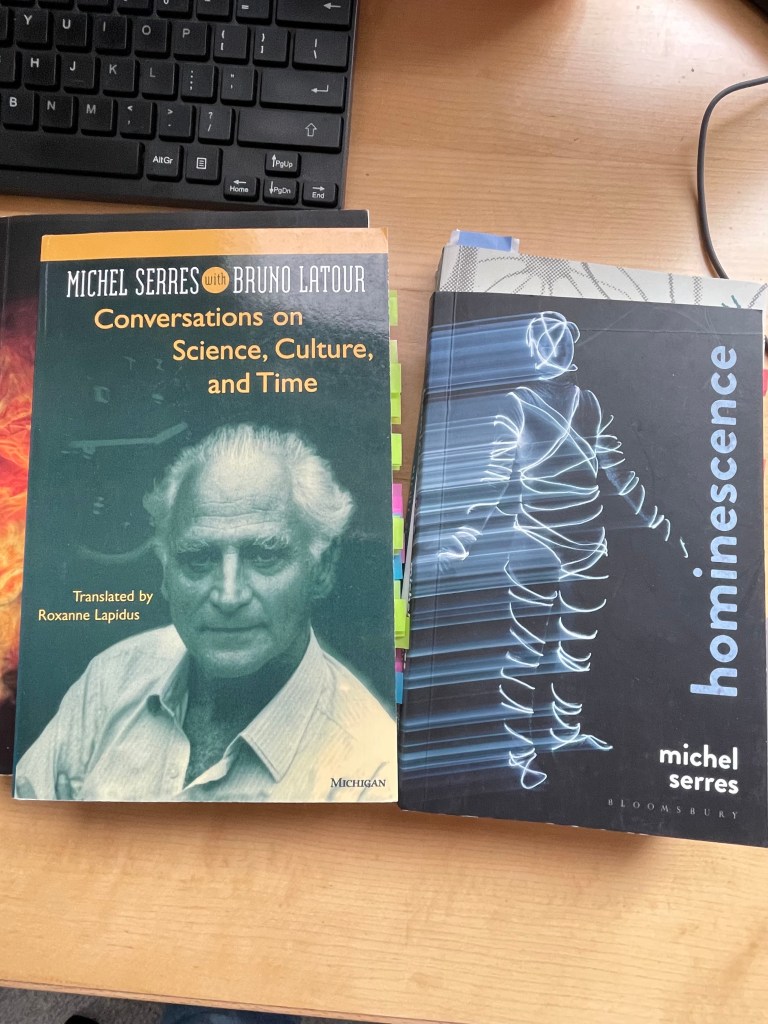
Michel Serres in Hominescence plays with “address” in different ways. The Gadamerian usage means a call, something in the world says to us, “Hey, look over here! Something’s up!” It also means a form of address, is it “Hey, you!” or is it “Excuse me, sorry to interrupt, but…” But address also means a location, a location pinned down within a system, a code. That’s how the package ordered online arrives in the right place and we can meet our friends at an agreed spot. Serres argues that address in this sense is on the way out. We call it an email address, but it belongs to us, not to a place, and we can access it wherever we have a connection.
Serres’ ideas about addresses give some new ideas for hermeneutic researchers, who routinely present incidents from their past as prompts towards the topic they have chosen for research. Often it was a “bad” communication where someone was abused or ignored or misunderstood by a healthcare provider, or maybe when someone said something out of the ordinary, that suddenly raised a question about a taken-for-granted slice of the daily routine. Serres’ reminder that verbal address can mean mode of address, that reveals assumptions about power and status, is a useful addition. Desire and valuation inflect all communication, and a good hermeneutic study must find ways to get at them. Gadamer set up an ideal “genuine conversation” and that has confounded researchers ever since, lured by the dream of complete equality in carrying out research interviews. There is, however, something self-regarding about this, that we think we can shuck off all the associations we take one with titles like “researcher,” or “doctoral student,” or even “nurse.”
Address also means a place in the world, defined within a system of codes, of street names and building numbers, cities and postcodes. What “addresses” the researcher happens somewhere. If it did not occupy space and involve actual people, it would hardly matter for nursing research. The researcher needs to pay attention to the detail, of who said what to whom – but in what kind of room, in what kind of institution, with what kinds of rules and routines, etc. Serres’ observation about the placelessness of electronic communication does not work so well here. Much of healthcare still necessarily requires buildings in which real things are done to real, present bodies. Even in remote care, there are bodies and places, even though provider and patient can be far apart from each other.
Up to now, the address of the topic as a call to attention invites the question, “what happened?” Serres’ reminder of other meanings of address invites further questions, “who was involved, and who are they to each other?”, and “where did this happen?” The where can be taken one step further. If an address needs a system of coding to work, what is the background network of codes that makes this moment of address a possibility? What kind of world needs to exist for such thing to happen at all?

I created this website as part of a research project to find out more about how nurses understand and make use of arts and humanities in their work. In 2023 I was successful in getting grant funding to go ahead with it. Since then, along with two graduate research assistants, Randip Dhaliwal and Davey Hamada (both PhD students in the Faculty of Nursing at the University of Calgary), we are about halfway to our goal of interviewing 20 participants.
So far it is about 80% nurses in clinical practice (some of whom are also graduate students) and 20% educators. I am pleased about that because I thought in planning this study that one of the gaps in the “literature” is about nurses who actually practice. What is published not surprisingly comes almost exclusively from academics who – like me – have a theoretical interest in humanities and nursing or who – also like me – have tried applying arts and humanities in teaching and research. A lot of this activity skirts around the problem I started to address in my book of how do we first show that there even is such a thing as “nursing and humanities” ie, combinations of the two that work and have meaning, and then how we can talk about it, whether describing it, explaining it, or promoting it (or all of the above, which is the goal of the project). If humanities do not have significance in nursing practice, by which I mean clinical practice, not secondary supporting practices of education, research, or management, then they are at best a take-it-or-leave-it option for nurses who happen to have an interest (and if that is the case, they are probably still worth taking a good look at).
One of the interviews was with a nurse working in oncology. What makes this interview stand out is that she found it quite difficult to explain why and how humanities are important in her work. In a way, that gets at the problem better than others who have decided ideas about their own uses of arts and humanities. This nurse, like others, used the term humanities quite loosely and almost interchangeably with humanity. How these terms work together is one of the questions I have when I see them in the health humanities literature. Both can be defined in many ways. But if one version of humanities is an image of 60s brutalist office blocks with signs over the door for university departments, “History,” “Modern Languages,” “Fine Arts” and so on, one version of humanity is a vast river delta where it meets the sea, a broad current of connotative virtue. It is impossible to hold down either sense of either word for long; better to sense the pull between the desire for definition and the allure of wholeness. (One way of thinking about this contrast is by mapping it to Charles Taylor’s “designative-instrumental” and “expressive constitutive” theories of language (Taylor, 2016, p. 48). What is occurring in the space in between humanities and humanity, in terms of what we have in this, and other interviews?
There is something to the idea that there are qualities of relating that people find important in nurse-patient encounters that have to do with “humanity” and therefore also with “humanities.” The part of the interview that sticks in my mind and which struck me forcefully when I went back and read it is about a nurse-patient encounter. The patient was a younger woman seriously ill with cancer, by herself in a single room. During a routine encounter, checking in, taking vital signs, she complained about the drabness of the room. The nurse, following an un-prescribable impulse, asked her what her favourite colour was. Yellow. They then talked about colours and the patient said she liked Van Gogh’s sunflowers. Following this conversation, the nurse found, and made, pictures of sunflowers and stuck them up in the patient’s room. Initial thoughts about this interaction I have:
Reference
Taylor, C. (2016). The language animal: The full shape of the human linguistic capacity. Belknap Harvard University Press.
This project draws on research supported by the Social Sciences and Humanities Research Council.


I have been thinking about things for a while now – by which I mean things, not words or concepts or ideas or language or discourses or conversations….
Nursing theory and research pay far too little attention to things, objects, stuff, materiality – between the so-called paradigms of qualitative and quantitative research there is a duopoly of abstraction, one using numbers and one using words, and both ignoring the physical world.
The divide between nurses who nurse and nurses who do what academics (including me) do is not a theory-practice gap, it is an abstraction-reality gap.
When I first read about carnal hermeneutics, I seized upon it as an acknowledgement, still using the framework of hermeneutics, of our understanding as embodied and tactile. That is still important though not enough.
Rilke, the 20th century German poet, is much loved by hermeneutic philosophers (German philosophers all want to be poets and vice versa, it seems) not least because of the epigraph to Truth and Method from a Rilke poem about needing two players to play throwing and catching.
That poem dates from 1922, towards the end of Rilke’s life. At an earlier stage of his career he wrote what he called a “poetry of things.” There is another poem from this period, also about a ball being thrown, but this time from the ball’s point of view.
…not quite Thing and yet still Thing enough
to have remained, unlooked for and unseen,
beyond us in the organized outside,
…point to the players their new stance,
suddenly from your height ordering them
as though they were a figure of the dance-
The Ball from New Poems Second Part trans Marielle Sutherland, Rilke (2011) p 103.
Here the ball shapes the movements of the players, the ball is thing and not-thing because its movement pulls people into shapes around itself. This image leaves out the meanings and values ascribed to the ball (a father and daughter playing catch, a World Cup Final?), the invisible network of rules and expectations that mediate between players and ball (can they touch it with hands or only feet, do they need a tool like a bat, or are they just trying not to drop it?) and who the players are to each other (team mates, opposing teams, individuals, adult and child?). The poem perfectly captures what Michel Serres calls a “quasi-object” in his book The Parasite (1980/2021). He makes the same point, using the example of a ball, that a quasi-object has people moving in relation to it. There is no deliberative choice about this, but a sensorimotor, in-the-moment responsiveness. He uses the example of rugby, filling in the picture more concretely – if you watch a game of rugby you can see the constantly shifting disposition of players in relation to the ball, how a change in possession from one team to the other immediately alters the direction of movement, and the postures of players as they change from attack to defence, or vice versa, and the ball changes from object of potential victory to threat of defeat.
Sandelowski (2003) wrote an essay about how qualitative research relies too much on the interview and thus on words and ignores objects. She points out how much nursing practice is constitutively about using tools in concrete sites of affordances and limitations of built environments (this is still true of virtual care – there has to be a compatible set of tools at either end of the encounter, and each person in the encounter is still somewhere, taking up space, just not the same space).
In another book, Hominescence (2001/2019), Serres brings attention to how much our human world has changed in a relatively short space of time – he was writing around the turn of the 21st century and looking back on his childhood in rural France in the 1930s. We barely notice material changes within our own lifetime and ignore those outside of it, even by a few years. In healthcare, human expectations about suffering, about pain, disease, and dying have changed in the light of modern medicine. Biomedicine, much maligned in qualitative and “critical” academic circles by people with the privilege of being able to ignore (or pretend to at least, until something goes wrong with their own body) the stubborn empirical fact that modern medicine, unprecedently in human history, works. It fixes things. It cures diseases. It takes away pain. It prolongs life. Every time, perfectly, without error or unwanted effects? Of course not, but when we look at all of those, and other areas for improvement, we are like seagulls following in the wake of a ship for scraps. The ship has to be there to begin with.
If you want to know what we, collectively, think about biomedicine, don’t listen to academics, follow the stuff. Close to where I am writing, a massive new cancer centre has been built, visible for miles around, due to open next year. It is the physical expression of social value and where we want to channel resources. It is the product of a vast desire to be relieved of the suffering and threat to life of cancer, compounded with the belief that it will work. It is biomedicine made concrete. It is a monumental symbol of what matters to its home society, like Stonehenge or Angkor Wat.
Zadie Smith in her novel NW, commenting on a generational difference between two characters (who would be aged around 50 now based on the setting of the novel) and their mothers:
“Nature becomes culture
Many things that had seemed, to their own mothers, self-evident elements of a common-sense world now struck Natalie and Leah as either a surprise or an outrage. Physical pain. The existence of disease. The differences in procreative age between men and women. Age itself. Death.
Their own materiality was the scandal. The fact of flesh.” p. 313
Nurses, in this world of what Richard Kearney calls “excarnation,” are among the groups in society who are still privy, in a tactile, everyday way, to the ongoing scandal of materiality, flesh, and death. This in spite of our best efforts to offload the dirty work on health care aides, or to tell ourselves we are really all about abstractions like “leadership,” or to chatter about values over actions.
“To carry the self forward and illuminate myriad things is delusion. That myriad things come forth and illuminate the self is awakening.”
Dogen, p. 29, from Actualizing the Fundamental Point (Genjokoan),
References
Dogen Zenji. (2010). Treasury of the True Dharma Eye (Shobogenzo), (Ed. & Trans. Tanahashi). Shambhala.
Kearney, R. (2021). Touch. Columbia.
Rilke, R.M. (2011). Rilke: Selected Poems. Oxford.
Sandelowski, M. (2003). Taking things seriously: studying the material culture of nursing. In J. Latimer (Ed.). Advanced qualitative research for nursing, pp. 185-210. Blackwell Science.
Serres, M. (2019). Hominescence (R. Burks, Trans.). Bloomsbury.
Serres, M. (2021). The parasite (R. Burks & L. Schehr, Trans.). PDF retrieved from https://www.academia.edu/45684409/The_Parasite_by_Michel_Serres_translated_by_Randolph_Burks_and_Lawrence_Schehr
Smith, Z. (2012). NW. Penguin.
For the past several years, on and off, I have been reading works by a French philosopher, Michel Serres (1930-2019). I came across his work, or one of his works, a book called The Five Senses, with a subtitle, A philosophy of mingled bodies, in an essay by Brian Treanor, the co-editor of the volume Carnal Hermeneutics.
Treanor picked up on Serres’ theme of mixtures, in contrast to the usual impulse in all kinds of thinking (including in nursing, the supposed “quantitative/qualitative” paradigm divide) towards trying to establish a zone of purity.
I followed up by reading the Five Senses. Reading Serres, I soon found, is hard work, at turns exhilarating, bewildering, and frustrating. It is worth it for the moments where a new idea opens up or a stunningly new way of thinking about an old idea. Serres begins the Five Senses with a gripping account of when he was trapped in a burning ship in his time as a naval engineer. He struggled to escape through a narrow porthole and got stuck, his legs exposed to increasing heat, his face to freezing sea spray. He was able to wriggle out and survived. In an interview with Bruno Latour, he is scornful of Merleau-Ponty, the great thinker of embodiment, for still being too theoretical, too bound to his desk. When you read the opening of the Five Senses, you can see what he means – and that he is dedicated to a quite different way of thinking philosophically with the world, and with what it is to be human now.
I have gone on to read several more books by Serres (the first translations date back to the 1980s and there has been an increasing number of English translations in the past few years, notably a series from Bloomsbury translated by Randolph Burks) and with each one I relive the feeling of being in the middle of something important but hard to get a hold of. I am greatly indebted to Christopher Watkin who brought out a book called Michel Serres: Figures of thought in 2020. It is the first overview in English of Serres’ work – although “overview” is a little unfair on what Watkin does in the book. He does help the reader find pathways of important ideas (the figures of the title) across Serres’ extensive works and he also addresses Serres’ style of writing and of thinking. He is careful to respect the importance of the mixture for Serres; of science and humanities, of scientific theory and literary reference, of mathematical models and personal anecdotes. Mixture is woven into the way he develops deep insights into aspects of the human condition and through the fabric of his writing – expressing our lived, mingled ways of making sense. Watkin’s book has given me the concepts to go back to Serres’ works with greater understanding and to begin to try to bring them into thinking with nursing.
Here are a couple of examples of Serres’ recurrent ideas, that resonate for me, modality vs ontology, and information processing.
Kearney, R. & Treanor, B. (2015). Carnal hermeneutics. Fordham University Press.
Serres, M. (2016). The five senses; A philosophy of mingled bodies (M. Sankey & P. Cowley, Trans.). Bloomsbury.
Watkin, C. (2020). Michel Serres: Figures of thought. Edinburgh University Press.

Modality vs Ontology
In a passage in Hominescence (2001/2019), evidently aimed at Heidegger, though Serres does not name him, he says “Being does not concern us…We exist neither as beings nor as Beings, but as modes. Our existence floats in the square of modality, where possible, impossible, necessary and contingent put up the four walls of our cultural and natural dwellings – body, technology, language, arts and world” (p. 49).
This is promising. It gets us off the hook, for thinking with nursing, of having to make profound-sounding statements about “ontology.” Having taught philosophical ideas for nursing to doctoral students for a few years, I have come the conclusion that ontology is a waste of time. We don’t stop to think what ontology we are even talking about – all matter, humans, nurses? All ontological statements are only ever a matter of belief, more or less well argued. And what humans believe they believe and how they operate in the world do not always (ever?) correspond too well. There is too much interference, noise as Serres would say, between intention and action, theory and practice, belief and action, word and deed. Noise in the mind, noise in the environment.
If I turn up in the emergency department with central chest pain, I don’t care if the triage nurse holds the ontological position we are co-creating bundles of holistic energy, or that I am a meat machine animated by electro-chemical impulses – as long as she knows I might have a blockage in a coronary artery, and what to do about it.
Ontological speculation is an indulgence for academics and graduate students.
Which brings us to Serres’ alternative proposal, of four modalities of “possible, impossible, necessary, and contingent.” My chest pain is necessary – it is happening, based on some contingent change, like a blockage to an artery – there are therefore possible courses of action, guided by scientific knowledge and local protocols, a competent nurse can prioritise and act accordingly. As a patient, I might want the impossible – make it go away, make it NOT be a heart attack (if in fact it is one) – the nurse has to differentiate, maybe help me negotiate the difference – what matters, right now, how much is my magical thinking getting in the way? More contingency, other possibilities.
This, as Serres put it in the passage above, is us floating “in the square of modality,” bouncing against the walls of “cultural and natural dwellings,” “body, technology, language, arts, and world.” His account forces us to take account of the reality of situated nursing practice, in a way that “Dasein” never can, except by vaguely gesturing in the direction of the world.
Serres, M. (2019). Hominscence (Trans. R. Burks). Bloomsbury.
Information Processing
One of the recurrent figures in Serres’ work is information processing. “Everything in the universe, humans included, receives, stores, processes, and emits information” (Watkin, p. 258). One example that Serres talks about in his later book Hominescence, is RNA which he sees as a text, as a genetic writing that precedes human ideographs or alphabets. Humans are not information processing machines, still less one that is centred in the brain as many neuroscientists maintain, but a multitude of layered information processing forms at different levels of complexity. Human language emerges from the noise of these layers in the organism as one – certainly distinctive – operation of rationality (Watkin, pp. 261-2).
Language is displaced from its primary place in hermeneutics and post-modern thought and is a certain kind of information processing, layered with many others.
From the point of view of health practitioners, this undercuts supposed oppositions between realms of art/science or quantitative/qualitative research methods; there are only various forms of information processing. This goes too, even more so, if the horizon extends to “health” as an aspect of human life. The means of investigation are determined by the phenomenon, which in the case of health, is manifold.
The four aspects of information processing in Serres’ thinking are receiving, processing/exchanging, storing, and emitting (Watkin, p. 260). In addiction for example, there are layers of information processing along neural pathways, exaggerations and diminutions of receptors and chemical activities, induced and instantiated in spirals of repeated behaviours; information processing of learned expectations of the world, rewards and denials, satisfactions and disappointment, presences and absences; for each individual, memories, pathways through surroundings, relationships with individuals, spoken words, idioms, slangs, symbols, exchanges.
Watkin, C. (2020). Michel Serres: Figures of thought. Edinburgh University Press.

Laurie Anderson: Language is a Virus
https://www.youtube.com/watch?v=KvOoR8m0oms
Knowledge Translation is defined as a dynamic and iterative process that includes synthesis, dissemination, exchange and ethically-sound application of knowledge to improve the health of Canadians, provide more effective health services and products and strengthen the health care system.
This process takes place within a complex system of interactions between researchers and knowledge users which may vary in intensity, complexity and level of engagement depending on the nature of the research and the findings as well as the needs of the particular knowledge user (Graham, 2010).
CIHR https://cihr-irsc.gc.ca/e/29418.html#2
“The man who used that voice had no native language. He had learned the use of an alien tool.”
The Ticket that Exploded, p. 9. William S. Burroughs
“The word is now a virus…The word may once have been a healthy neural cell. It is now a parasitic organism that invades and damages the central nervous system…The word is spliced in with the sound of your intestines and breathing with the beating of your heart.”
The Ticket that Exploded, p. 50. William S. Burroughs
The academic-bureaucratic complex demands first that all thought is translated into its lingua franca, which is in English but not English. It is deracinated, universal, transmissible – it emanates an aura of authority and truth, yet can be used as readily to express utter nonsense as sound scientific knowledge. Like Latin in medieval Europe, it is the language of political and religious elites – inasmuch as modern university scholars overlap in their social and ideological functions with priests and monks. Knowledge, from the researcher to you, the mere “user” of knowledge, has already been translated.
Translation broken down into its Latin roots means simply carrying across – taking something from one place and putting it down in another. Translation commonly means taking words from one language and carrying the meaning across to put it down in another language. However: “Life is not just crossing a field” as Boris Pasternak wrote – originally in Russian. Read the translator’s introduction to any work of literature and you will soon learn it is not so simple.
The definition of knowledge translation quoted above mentions complexity, twice, in the conditions under which the process of knowledge translation takes place. I don’t think this is quite the same thing as acknowledging the inherent complexity of translation itself. For one thing, KT (words translated into letters – we’re all busy people) appears to assume that knowledge in the end is being carried from place to place, from the hands of researchers to knowledge users. Whereas in fact, knowledge is being converted into practice, which is enacted knowledge. George Steiner, in his magisterial work on translation, After Babel, introduces a term of Roman Jakobson’s, “transmutation” to indicate not simply translation but “an intersemiotic process” (p. 274) from one form of communication to another. Steiner gives as examples of intersemiotic forms, plotting graphs, dance or music. These are a long way from the usual concerns of KT but the principle applies if we take note of the embodied forms of dancing or music making. Healthcare practices, where the actions of clinicians are required to shift in the light of new knowledge, are also embodied forms – moving differently in space in response to new objects or processes, or in another sense, the patient’s body ingesting a new drug and the observation of its visible effects.
Steiner is chiefly concerned with translation of literary texts, not of technical texts that are designed for functional communication, and he does not pursue Jakobson’s point about translation between forms except in the case of music. But coming from the world (and its language games – Wittgenstein) of healthcare research and taking the textual avatars of KT at their word, it is worthwhile taking the translation in KT at its word, and considering it in the light of what Steiner had to say about it.
George Steiner proposed a four-part hermeneutic of translation, thinking primarily in terms of translating literary texts. First, trust, that there is meaning to be had in the text – that translation is worth it. Second, aggression, the translator “invades, extracts and brings home” (p. 314). Meaning is not simply transferred but has to be seized and brought into shape, as a sculptor uses force to produce form from a block of stone (however smooth, however light the final effect). Third, there is adjustment to the new meaning in a new language, Steiner employs a string of words for this, “incorporation…embodiment…incarnation…infection” (pp. 314-5). Lastly, there is “an enactment of reciprocity to restore balance” (p. 316).
Here I attempt to follow Steiner’s steps through the KT process.
The researcher needs to trust that the new knowledge is worth it, but so do the end users. Unlike literary translation, where a translated text can be published and it is then up to potential readers to decide if they think it was worth translating, in KT the “potential readers” are already implicated in the translation. Trust is mingled with authority. Good evidence-informed practitioners will, in general, “trust” the new evidence provided they can see it has been arrived at through proper methods, but in each particular case, they may have their own ideas about how valuable the new knowledge is to them. At the same time, the “translation” takes place within institutional power structures that are not equivalent to the literary-market concerns of translators, agents, publishers, and book buyers. A family doctor has discretion about which drugs to prescribe, nurses in hospitals have none at all about a new computer operating system being introduced. There can still be trust – that the system works, that it will have better functionality than the old one – but there is also unmistakeably authority.
Steiner’s second stage is compatible with the element of authority, making plain the element of force entailed in transformation, of words from one language to another, or a new idea into changed practices. But here the translation metaphor is imperfect. If, as Steiner puts it, the translator “invades, extracts, and brings home” (p. 314), who is the translator and where is home? If home is the new language of the translation, that is for the benefit of readers in that language who do not have fluency in the original, but in KT, the translator and reader are in effect the same – the end-user. The hinge of translation is not with the researcher, but with the end-user. Home is where the practice is. Invasion, extraction might refer to the “text” of the research, translated from academic language into usable terms for practitioners, but they also apply to the incursion into current practices – which need to be “translated” into new practice. These are the raw material that has to be reformed into something new.
The third stage of the hermeneutic is the most readily transferable (translatable?) to KT. Everyone knows basic change theory, the period of adaptation that follows the disruption of change. Steiner’s terms, however, are telling since they are all bodily, organic metaphors. If KT entails “an intersemiotic process,” not so much from one language to another as one form of communication to another, it is about embodied practice. As such it needs to be not only learned but used, to become natural to the user. Infection is a curious choice by Steiner. It is reminiscent of Burroughs but has a worrying hint that incorporation of the translated might have negative effects. It is a rare change in practice, in a complex context, that does not have some unforeseen, unwanted effects even when they might be greatly outweighed by benefits. More positively, incarnation and embodiment, among Steiner’s other stage three words, point to the end result of doing things differently in the light of new knowledge. With these organic metaphors, Steiner points to a process of absorption, not simply a rational, cognitive learning of new knowledge, but letting new knowledge work its way into an interconnected system like the body, circulating, and entering tissue. He says, “the act of importation can potentially dislocate or relocate the whole of the native structure” (p. 315). KT is not about knowledge in separated minds but ways-of-thinking and ways-of-doing in existing networks of multi-layered relationships that make up institutional ecologies. Again, it is not the home-structure of the researcher that stands to be dislocated but that of the recipient of the knowledge.
Continuing his metaphor of infection, Steiner warns, “the native organism will react…to neutralize or expel the foreign body” (p. 315). Some translations fail – they are not faithful enough to the original meaning, or they do not sound like the target language. In KT, there is perennial worry about change not happening as intended, often couched in terms of resistance from those who should know better. Years ago I witnessed an attempt to introduce the Tidal Model on an in-patient mental health unit. It is a model of mental health nursing that is patient focused, built around the patient’s account of their own difficulties in living – in some ways similar to principles of trauma-informed care now in vogue. The model involved a lot of paperwork (actual paper, pre-computer system) that took some getting used to though it comprised a logical structure of directed assessment and collaborative care planning. Educators on the unit went to great lengths to introduce the model, in the end unsuccessfully. The native organism, in the form of established beliefs and practices – and in the person of some powerful personalities among the nurses, did indeed react to neutralize and eventually expel the foreign body. Going back to Steiner’s first stage, implementation in this case did depend on trust – in the model, in the educators – and without additional institutional authority, which approved of but did not require the new practice. The infection was not strong enough for the immune system.
Steiner’s fourth and final phase is “enactment of reciprocity in order to restore balance” (p. 316). This sounds like the integration of new knowledge/practice to the point where people no longer think of it as new anymore, as when a new building goes up in the neighbourhood and it quickly becomes hard even to recall what was there before. The reciprocity in KT could be seen as the necessary adaption of the new knowledge to the setting and as whatever learning researchers might take away about the practitioners’ view of things.
In KT, who is the translator? When researchers apply for grants, they are expected to write in their KT plans, which suggests they are in charge of translation. But increasingly, there is an expectation of a more participatory model where end-users are involved in earlier stages of projects. Are they translating practice to research in a feedback loop? Partly perhaps. But a feedback loop like an eddy in a flowing river – the river is still heading to the sea. The CIHR guide is clearly one-way. By whatever means, superior knowledge is to be delivered over to practitioners and alchemically transformed into better practice (for the health of Canadians etc).
To take KT at its word, as a metaphor for once, rather than to take it in the other direction, towards implementation science with its promise of stable variables and measurable degrees of certainty, is to admit the metaphor, like all metaphors, has its limits. But that is why we use them, they both illumine meaning and unsettle it, provide precision – and provoke by its absence towards greater clarity.
Steiner, G. (1998). After Babel: Aspects of language and translation (3rd ed.). Oxford University Press.

 Nursing and Humanities