For the past several years, on and off, I have been reading works by a French philosopher, Michel Serres (1930-2019). I came across his work, or one of his works, a book called The Five Senses, with a subtitle, A philosophy of mingled bodies, in an essay by Brian Treanor, the co-editor of the volume Carnal Hermeneutics.
Treanor picked up on Serres’ theme of mixtures, in contrast to the usual impulse in all kinds of thinking (including in nursing, the supposed “quantitative/qualitative” paradigm divide) towards trying to establish a zone of purity.
I followed up by reading the Five Senses. Reading Serres, I soon found, is hard work, at turns exhilarating, bewildering, and frustrating. It is worth it for the moments where a new idea opens up or a stunningly new way of thinking about an old idea. Serres begins the Five Senses with a gripping account of when he was trapped in a burning ship in his time as a naval engineer. He struggled to escape through a narrow porthole and got stuck, his legs exposed to increasing heat, his face to freezing sea spray. He was able to wriggle out and survived. In an interview with Bruno Latour, he is scornful of Merleau-Ponty, the great thinker of embodiment, for still being too theoretical, too bound to his desk. When you read the opening of the Five Senses, you can see what he means – and that he is dedicated to a quite different way of thinking philosophically with the world, and with what it is to be human now.
I have gone on to read several more books by Serres (the first translations date back to the 1980s and there has been an increasing number of English translations in the past few years, notably a series from Bloomsbury translated by Randolph Burks) and with each one I relive the feeling of being in the middle of something important but hard to get a hold of. I am greatly indebted to Christopher Watkin who brought out a book called Michel Serres: Figures of thought in 2020. It is the first overview in English of Serres’ work – although “overview” is a little unfair on what Watkin does in the book. He does help the reader find pathways of important ideas (the figures of the title) across Serres’ extensive works and he also addresses Serres’ style of writing and of thinking. He is careful to respect the importance of the mixture for Serres; of science and humanities, of scientific theory and literary reference, of mathematical models and personal anecdotes. Mixture is woven into the way he develops deep insights into aspects of the human condition and through the fabric of his writing – expressing our lived, mingled ways of making sense. Watkin’s book has given me the concepts to go back to Serres’ works with greater understanding and to begin to try to bring them into thinking with nursing.
Here are a couple of examples of Serres’ recurrent ideas, that resonate for me, modality vs ontology, and information processing.
Kearney, R. & Treanor, B. (2015). Carnal hermeneutics. Fordham University Press.
Serres, M. (2016). The five senses; A philosophy of mingled bodies (M. Sankey & P. Cowley, Trans.). Bloomsbury.
Watkin, C. (2020). Michel Serres: Figures of thought. Edinburgh University Press.

Modality vs Ontology
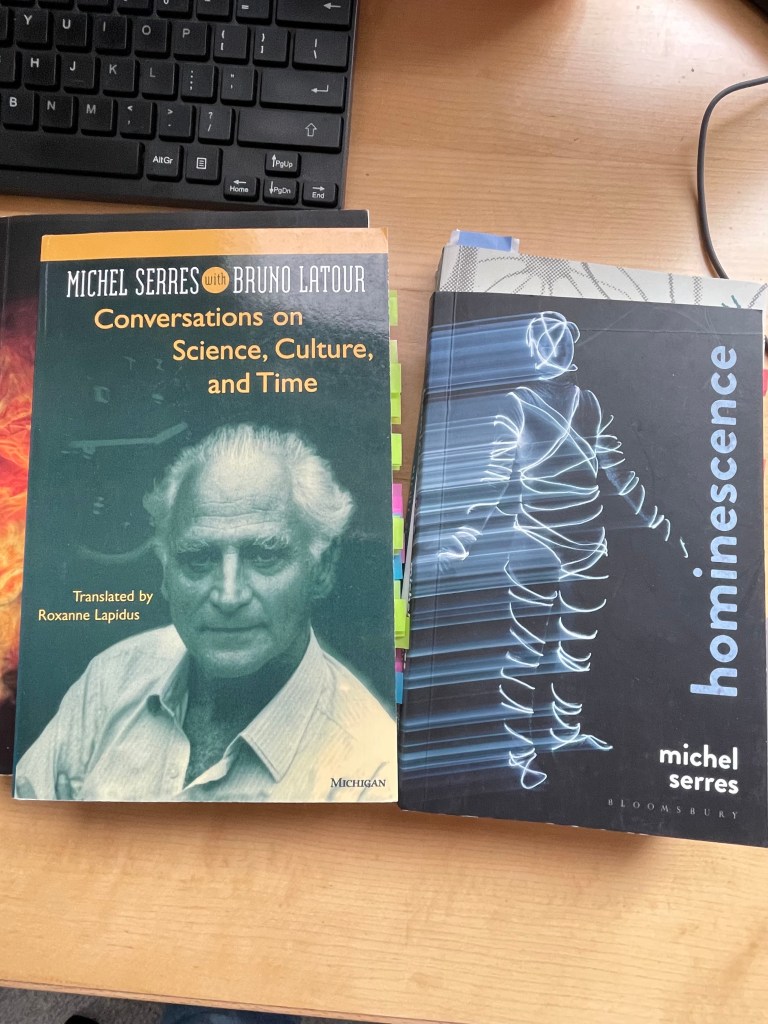
In a passage in Hominescence (2001/2019), evidently aimed at Heidegger, though Serres does not name him, he says “Being does not concern us…We exist neither as beings nor as Beings, but as modes. Our existence floats in the square of modality, where possible, impossible, necessary and contingent put up the four walls of our cultural and natural dwellings – body, technology, language, arts and world” (p. 49).
This is promising. It gets us off the hook, for thinking with nursing, of having to make profound-sounding statements about “ontology.” Having taught philosophical ideas for nursing to doctoral students for a few years, I have come the conclusion that ontology is a waste of time. We don’t stop to think what ontology we are even talking about – all matter, humans, nurses? All ontological statements are only ever a matter of belief, more or less well argued. And what humans believe they believe and how they operate in the world do not always (ever?) correspond too well. There is too much interference, noise as Serres would say, between intention and action, theory and practice, belief and action, word and deed. Noise in the mind, noise in the environment.
If I turn up in the emergency department with central chest pain, I don’t care if the triage nurse holds the ontological position we are co-creating bundles of holistic energy, or that I am a meat machine animated by electro-chemical impulses – as long as she knows I might have a blockage in a coronary artery, and what to do about it.
Ontological speculation is an indulgence for academics and graduate students.
Which brings us to Serres’ alternative proposal, of four modalities of “possible, impossible, necessary, and contingent.” My chest pain is necessary – it is happening, based on some contingent change, like a blockage to an artery – there are therefore possible courses of action, guided by scientific knowledge and local protocols, a competent nurse can prioritise and act accordingly. As a patient, I might want the impossible – make it go away, make it NOT be a heart attack (if in fact it is one) – the nurse has to differentiate, maybe help me negotiate the difference – what matters, right now, how much is my magical thinking getting in the way? More contingency, other possibilities.
This, as Serres put it in the passage above, is us floating “in the square of modality,” bouncing against the walls of “cultural and natural dwellings,” “body, technology, language, arts, and world.” His account forces us to take account of the reality of situated nursing practice, in a way that “Dasein” never can, except by vaguely gesturing in the direction of the world.
Serres, M. (2019). Hominscence (Trans. R. Burks). Bloomsbury.
Information Processing
One of the recurrent figures in Serres’ work is information processing. “Everything in the universe, humans included, receives, stores, processes, and emits information” (Watkin, p. 258). One example that Serres talks about in his later book Hominescence, is RNA which he sees as a text, as a genetic writing that precedes human ideographs or alphabets. Humans are not information processing machines, still less one that is centred in the brain as many neuroscientists maintain, but a multitude of layered information processing forms at different levels of complexity. Human language emerges from the noise of these layers in the organism as one – certainly distinctive – operation of rationality (Watkin, pp. 261-2).
Language is displaced from its primary place in hermeneutics and post-modern thought and is a certain kind of information processing, layered with many others.
From the point of view of health practitioners, this undercuts supposed oppositions between realms of art/science or quantitative/qualitative research methods; there are only various forms of information processing. This goes too, even more so, if the horizon extends to “health” as an aspect of human life. The means of investigation are determined by the phenomenon, which in the case of health, is manifold.
The four aspects of information processing in Serres’ thinking are receiving, processing/exchanging, storing, and emitting (Watkin, p. 260). In addiction for example, there are layers of information processing along neural pathways, exaggerations and diminutions of receptors and chemical activities, induced and instantiated in spirals of repeated behaviours; information processing of learned expectations of the world, rewards and denials, satisfactions and disappointment, presences and absences; for each individual, memories, pathways through surroundings, relationships with individuals, spoken words, idioms, slangs, symbols, exchanges.
Watkin, C. (2020). Michel Serres: Figures of thought. Edinburgh University Press.
 Nursing and Humanities